
Lens Review: Bausch & Lomb 32mm f4.5 Tessar Series Ic Leica M conversion


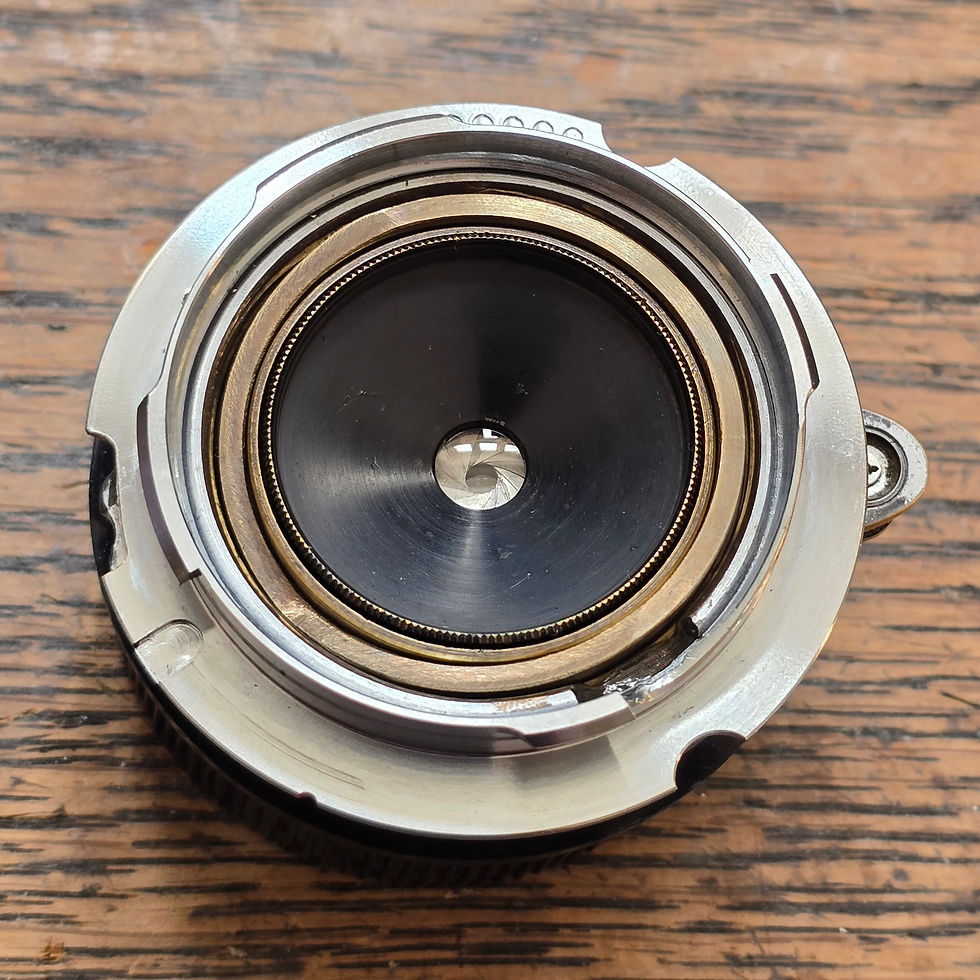
I stumbled across this lens mid 2025, I'd never seen such a wide early Tessar before and a quick inspection revealed a short flange distance, instant internal thought 'Leica M conversion potential, buy it!'. With the lens acquired it went straight off for conversion and what a great job the Master did. Fitted to an Industar helicoid that has been dechromed and blued, it looks like an original LTM lens.
Whilst the lens was away I started my research. Google offered nothing, always interesting, so I searched for past Bausch & Lomb catalogues and found it first offered on page 32 of the 1920 brochure as a cine lens 'for wide angle effects'.
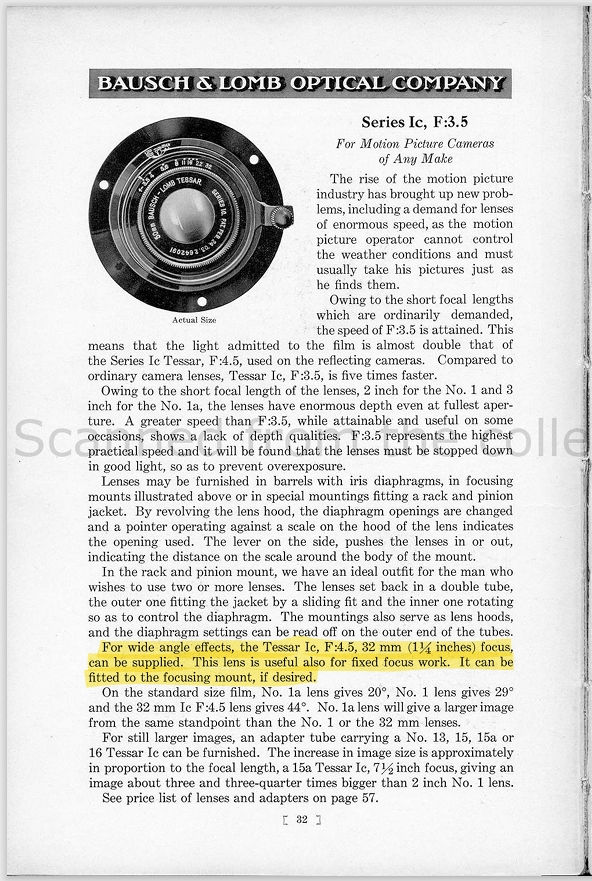

Images scanned from the collection of Larry S. Pierce.
Further into the catalogue is the price list where it shows the 32mm Ic listed with the coverage and product code word (SKU) 'Hangle' or in this case 'Hanglefocus', very pleasing to say. The coverage is reordered as roughly 25.5x19mm but this lens covers a bit more than the 35mm frame (36x24mm). I can only assume that the centre of the image circle was intended to be used. The price of $45 in 1920 adjusted for today is equivalent to $730.

Specification | |
Year of Manufacture | released in 1920 |
Country of Origin | USA |
Focal Length | 32mm |
Maximum Aperture | f4.5 |
Minimum Aperture | f22 |
Number of Aperture Blades | 16 |
Aperture Blade Shape | Curved |
Optical Construction | Tessar, 4 elements in 3 Groups |
Special Elements (ED, Aspherical, etc.) | None |
Coatings | None |
Minimum Focus Distance | RF coupled to .7m uncoupled to .5m |
Focus Mechanism | Manual |
Filter Thread Size | 26mm |
Dimensions (Length × Widest Ø) | 28.5x50mm |
Weight | 124g |
Weather Sealing | No |
Hood | None that I've found |
Original MSRP | See the original advert above |
Current Market Price (based on past sales & condition) | No recorded sales, none available. |
Availability (Mythical/Rare/Uncommon/Common) | Mythical! |
Sample Images
All of these images are low jpegs, taken on an M11 and uploaded straight from camera. Click to expand and see labels
Optical Performance
Sharpness
Wide Open – Centre | Very sharp, even wide open |
Wide Open – Edges / Corners | Sharpness remains good across the frame falling off ever so slightly at the edges |
Stopped Down Performance | slightly better |
Sweet Spot Aperture | At f8 it's evenly sharp across the whole frame |
Close Focus Sharpness | At .5m it's very good |
Rendering
Contrast | Low to moderate, especially in backlit scenes |
Microcontrast | Consistently muted, especially in midtones. Fine textures (fur, leaves, brickwork) show clear detail with slightly softened edges |
Colour Rendition | Slight warm bias, especially in skin tones, foliage, and highlights. Greens and reds are pleasing and natural |
Saturation | Very low, filmic |
Bokeh
Background Smoothness | Consistently soft and non-distracting, even in busy environments like foliage. |
Foreground Bokeh | Slightly more textured than background but still pleasing, adds depth without becoming nervous |
Bokeh Ball Shape | Slightly oval |
Cat’s Eye Effect | Clearly visible in several images (especially highlights and flare scenes) becomes more pronounced toward the frame edges |
Onion Rings / Outlining | None |
Focus Transition | Very smooth and gradual |
Aberrations & Corrections
Distortion | Very minimal. Architectural lines remain largely straight, even in wide scenes |
Vignetting (Wide Open) | Mild, noticeable in portraits and brighter scenes |
Vignetting (Stopped Down) | Reduces quickly when stopped down |
Lateral CA | Very well controlled, minimal colour fringing on high-contrast edges |
Longitudinal CA | Slight in some high-contrast transitions, but generally well suppressed. No strong magenta/green fringing |
Flare & Ghosting
Shooting Into Light | Mixed but characterful, strong flare in direct sun (large rings, veiling haze) and softer glow in indirect backlight |
Contrast Loss | Noticeable in strong light, produces a dreamy, atmospheric look rather than harsh washout |
Ghosting Artifacts | Large, soft-edged flare artifacts Circular/elliptical forms |
Hood Effectiveness | I didn't have one to test, but using my hand to shade the lens helped a lot when putting the sun near the edge of the frame |
Summary & Comparison to Similar Lenses
This lens has a distinctive rendering defined by a lovely smooth bokeh and subtle subject separation. Colour rendition is pleasing with a subtle warmth that enhances foliage, skin tones, and highlights. Flare is handled well with a gentle haze and occasional artifacts that can be quite atmospheric. Distortion is minimal and chromatic aberration is well controlled, keeping images clean. Sharpness is good, clear detail with slightly softened edges. Overall contrast and microcontrast remain relatively low, giving images a softer, more cinematic feel.
In terms of rendering, this lens shares some similarities with uncoated Tessar designs (primarily produced by Carl Zeiss before the mid-1940s), such as the Carl Zeiss Tessar 2.8cm f/8 for Contax rangefinder and early uncoated Rolleiflex 75mm f/3.5 Zeiss Tessars, as well as most pre-“T” coated Tessars. These lenses are known for their lower contrast, warmer colour rendering, and low flare resistance. However, while classic Tessars often exhibit higher contrast and much better central sharpness, this lens leans more toward softer contrast and gentler microcontrast, trading some bite for smoother tonal transitions. The result is a rendering that feels unique, using an antique lens like this is genuinely a very special experience and I will be using it until it finds it's new home!


another really excellent article. Thank you for taking the time to write these pieces. It's much appreciated.