
Lens Review: Kodak Ektar 47mm f2 Leica M conversion


We found this superb example of the coveted 47mm Ektar on our recent trip to Hong Kong. We had it converted to Leica M mount with rangefinder coupling by the Master who used a quality all brass Yifeng helicoid and made a custom aperture house, blades and control ring, also all brass. This makes aperture changing very easy. You can view this conversion for sale here.
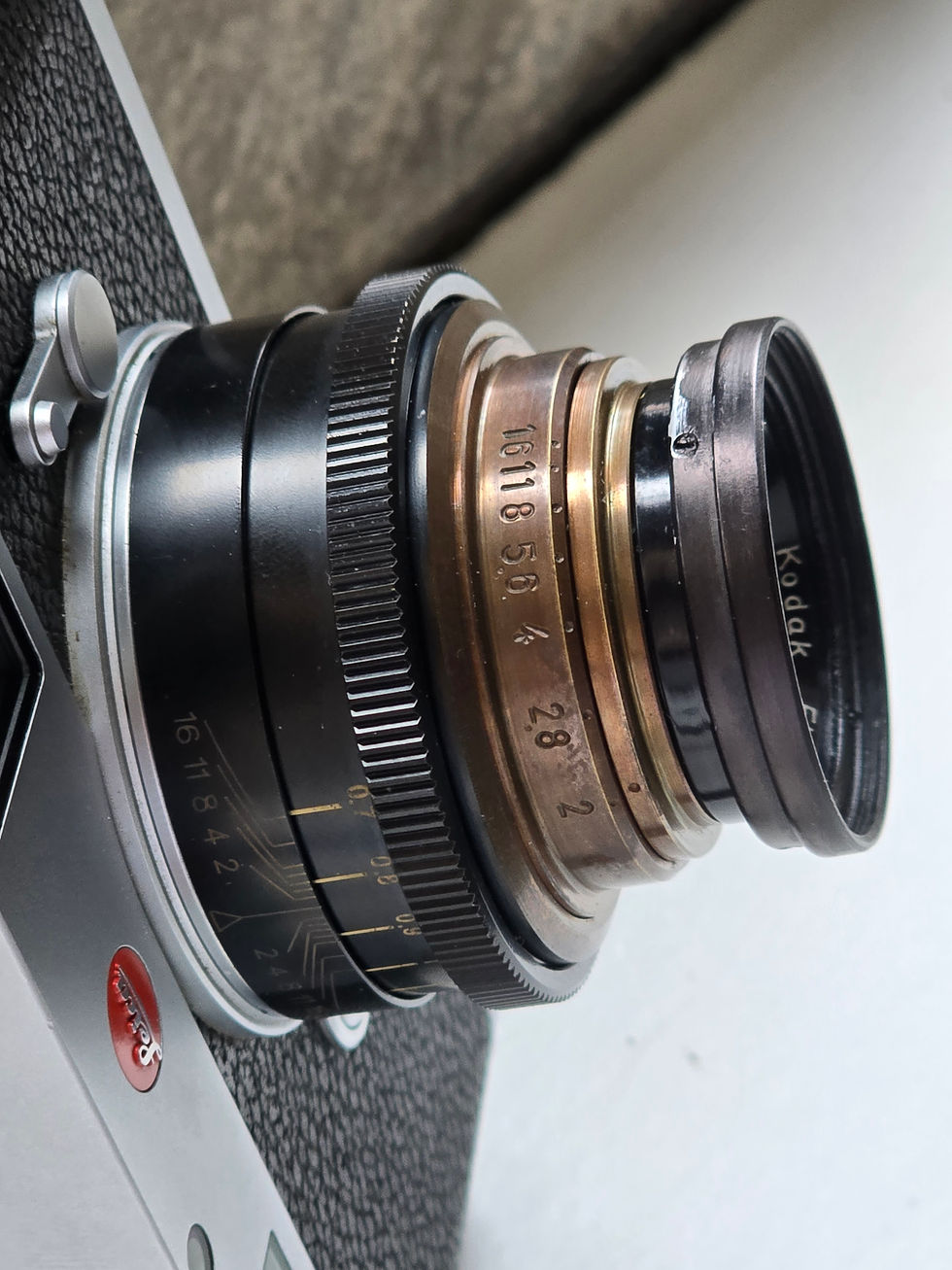
Originally offered on the Kodak Kardon rangefinder in LTM mount from 1945 and then Retina II from 1946-49. Many converted 47mm Ektars use the original leaf shutter that housed the lens as it contains the aperture. Whilst some people like this style of conversion I've always found them quite clunky looking and not at all ergonomic to change your aperture. The custom aperture work we commissioned for this lens is much easier to use and the machine worked brass looks lovely, yes that does matter!
This is how to date Kodak Anastigmat Special/Anastar and Ektar lenes FROM 1940-69. Prior to about 1940 Kodak used a single numeric sequence e.g. 54321. Serial numbers after that were alpha- numeric, two letters and three or four numbers e.g. ES3682. The letters in the USA were mapped to the word "CAMEROSITY", while in England, the mapping was to "CUMBERLAND".
C | A | M | E | R | O | S | I | T | Y |
1 | 2 | 3 | 4 | 5 | 6 | 7 | 8 | 9 | 0 |
C | U | M | B | E | R | L | A | N | D |
EY = 1940 | RY = 1950 | OY = 1960 |
EC = 1941 | RC = 1951 | OC = 1961 |
EA = 1942 | RA = 1952 | OA = 1962 |
EM = 1943 | RM = 1953 | OM = 1963 |
EE = 1944 | RE = 1954 | OE = 1964 |
ER = 1945 | RR = 1955 | OR = 1965 |
EO = 1946 | RO = 1956 | OO = 1966 |
ES = 1947 | RS = 1957 | OS = 1967 |
EI = 1948 | RI = 1958 | OI = 1968 |
ET = 1949 | RT = 1959 | OT = 1969 |
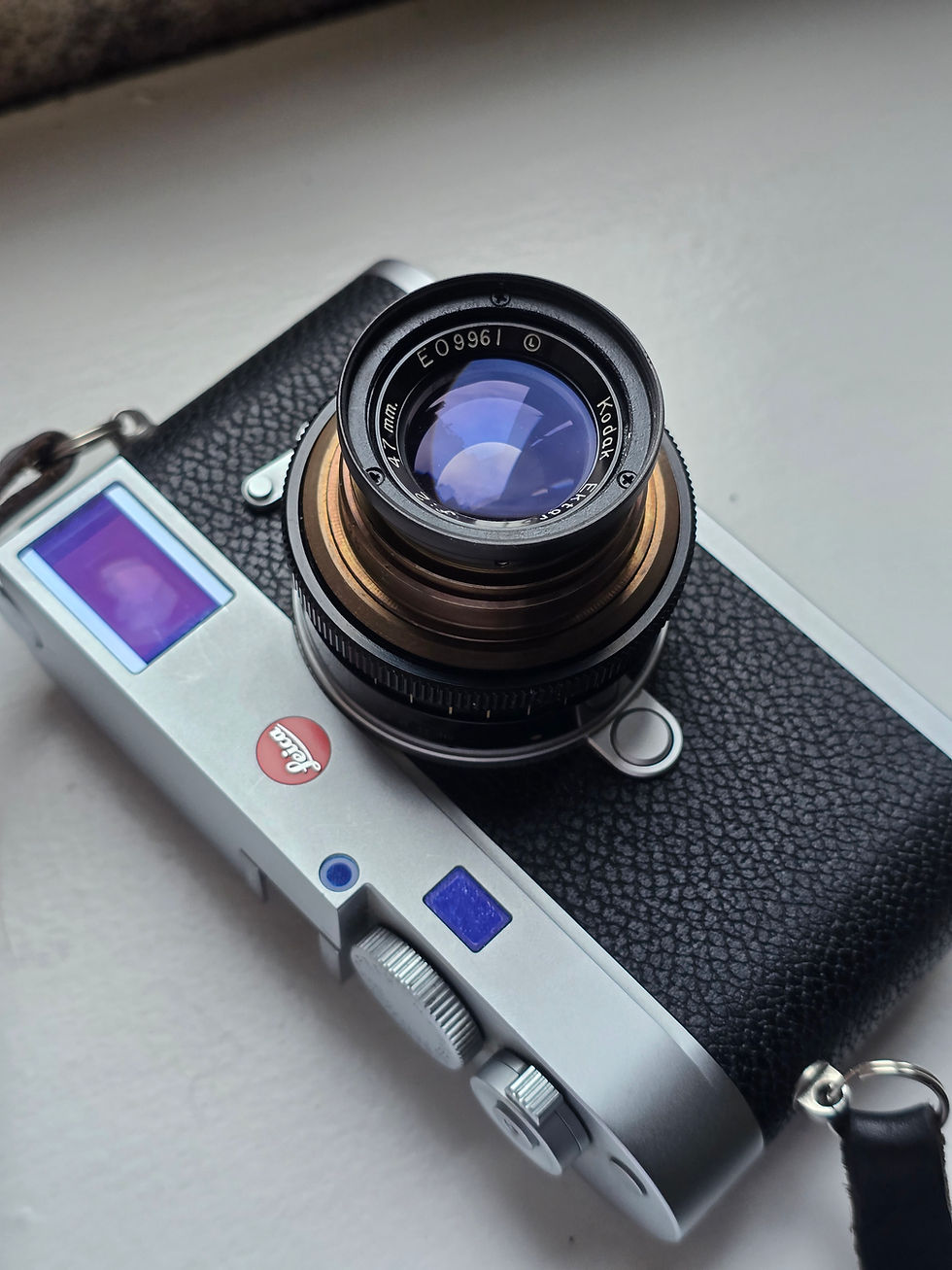
We can deduce that this example was US manufactured in 1946. The front ring also bares the engraving of a circled 'L' indicating it is "Luminized", Kodak's term for anti-reflective coating that was introduced in 1946.
Specification | |
Year of Manufacture | 1946 |
Country of Origin | USA |
Focal Length | 47mm |
Maximum Aperture | f2 |
Minimum Aperture | f16 |
Number of Aperture Blades | 12 |
Aperture Blade Shape | Curved |
Optical Construction | Double Gauss, 6 elements in 4 Groups |
Special Elements (ED, Aspherical, etc.) | None |
Coatings | Yes, 'Luminized' single coating |
Minimum Focus Distance | RF coupled to .7m uncoupled to .5m |
Focus Mechanism | Manual |
Filter Thread Size | Adapted to 37mm |
Dimensions (Length × Widest Ø) | 47x54mm |
Weight | 245g |
Weather Sealing | No |
Hood | Originally on the Retina II had a push on style hood. |
Original MSRP | The only catalogue price I could find for a Retina II with 47mm Ektar was from 1951 at $160USD. Approximately $2000USD today. |
Current Market Price (based on past sales & condition) | In original LTM mount £1200-1500 M mount converted £700-900, less for poorer quality conversions. |
Availability (Mythical/Rare/Uncommon/Common) | Rare |
Sample Images
All of these images are low jpegs, taken on an M11 and uploaded straight from camera. Click to expand and see labels
@f2 @f2 @f8 @f2 @f2 @f2 mixed light @f2 Window light @f2 @f2 Flare @f2 exaggerated phone torch @f2 @f8
Optical Performance
Sharpness
Aspect | Notes |
Wide Open – Centre | Impressive sharpness |
Wide Open – Edges / Corners | Sharpness falls off quickly moving out from centre |
Stopped Down Performance | Improves 1–2 stops down |
Sweet Spot Aperture | f8 - sharpness across the frame is excellent |
Close Focus Sharpness | Clean subject isolation, gentle detail rendering |
Rendering
Contrast | Moderate, stronger than expected for single coating |
Microcontrast | A good tonal range in darker areas |
Colour Rendition | Very warm, even in shade |
Saturation | Moderate |
Bokeh
Background Smoothness | Smooth, creamy blur with oval shaped highlights |
Foreground Bokeh | Soft and unobtrusive |
Bokeh Ball Shape | Oval |
Cat’s Eye Effect | Mild, increases towards frame edges |
Onion Rings / Outlining | Some outlining, double line "ni-sen" type |
Focus Transition | Fairly gentle |
Aberrations & Corrections
Distortion | Very little distortion |
Vignetting (Wide Open) | Mild, aesthetically pleasing |
Vignetting (Stopped Down) | Reduces quickly when stopped down |
Lateral CA | Designed for high-level correction of lateral CA. Important for Kodachrome |
Longitudinal CA | Minimal |
Flare & Ghosting
Shooting Into Light | Generally very good control but you can get a strong flare with a strong light in the corner of the frame |
Contrast Loss | Present but pleasing |
Ghosting Artifacts | Orb-shaped artifacts with purple/pinkish tint |
Hood Effectiveness | Coating is quite effective, a hood would help when shooting strong lights |
Summary & Comparison to Similar Lenses
Centre sharpness is very good, just sharp enough without being bleakly clinical. Instead, the Ektar delivers a gently refined sharpness with smooth transitions that feel organic and filmic. Character wise, the Ektar shares qualities with:
Some early Zeiss Tessar and Schneider Xenotar designs, known for balanced contrast and graceful highlight behaviour.
Leica Elmar and early Summitar lenses, especially in flare and how midtones are rendered.
For me, the bokeh is one of the standout qualities of this lens. The background blur is gradual, with pleasing Ni-Sen qualities and a subtle, natural cat’s-eye effect toward the frame edges when shot wide open. Combined with a slightly warm, rich colour bias typical of Kodak optics, shooting wide open is addictive.


Comments